Today's Hours:08:20-21:30
>>

Today's Hours:08:20-21:30
>>
About Us
Main Lib. and Medical Lib. Closed from 10/25 to 10/26 for Taiwan Retrocession Day
The Main Library and Medical Library will be closed from October 25 to 26 for Taiwan Retrocession Day.
The KnowLEDGE remains open as usual.

Contact Person Collection Management and Circulation Services Division
Telephone Ext.65760
E-Mail em65760@email.ncku.edu.tw
New arrivals for 13 English books, 49 Chinese books, 2 Japanese books --> New Arrivals
[ ~10/31 ] 2026 Medical Library Back-to-School Courses & Activities
The Medical Library is offering a series of activities for the new semester.
Everyone is welcome to join the courses and activities, with opportunities to receive small gifts along the way!
>>> Visit the Activity Website
|1. Yes or No! 8-Question Challenge [ Play Online ]
Now –10/31(Sat.)
A 1-minute online ⭕❌ challenge about the Medical Library and its resources.
Answer all 8 questions correctly to enter the prize draw.
9/22–9/23 Only [* Ended ]-------------------------------------------------
Complete the challenge and show your completion screen at the Medical Library counter to receive a limited-edition welcome gift.
|2. Medical Database Booths [* Ended ]
9/ 22 (Tue.) – 9/23 (Wed.) | 10:00 AM–4:30 PM
Front Corridor, Medical Library
Explore medical databases and meet the database providers. Small gifts are available!
|
Date |
Provider |
Resources |
|
9/22-9/23 |
SRIS |
AccessMedicine · AccessPharmacy · Cochrane Library · Micromedex · Web of Science [AI] |
|
9/22-9/23 |
Elsevier |
ClinicalKey [AI] · Embase · ExpertPath · Scopus [AI] · STATdx |
|
9/22-9/23 |
EBSCO |
CINAHL · DynaMed · EBSCOhost [AI] |
|
9/22–9/23 |
FlySheet |
MEDLINE (Ovid) · Primal Pictures · Sanford Guide |
|
9/23 Only |
UpToDate |
UpToDate [AI] · UpToDate Lexidrug |
|3. SR Search Courses [ Course Information & Sign Up ]
2 Sessions | September & November
Learn practical strategies for conducting literature searches for systematic reviews using major medical databases.
Whether you are returning for more practice or just getting started, everyone is welcome.
|4. [Course] Getting Started at the Library [ Sign Up ]
An introductory session covering library orientation and basic medical database searching.
10/6 (Tue.) | 2:10–4:00 PM
Medical Library, Computer Room (1F)
|5. [Course] EndNote Basics for Win/Mac [ Sign Up ]
Learn the basics of reference management and how to retrieve full-text articles using EndNote on Windows or Mac.
10/13 (Tue.) | 2:10–4:30 PM
Medical Library, Computer Room (1F)
|6. [Course] Research Smarter with AI [ Sign Up ]
Get hands-on experience with WoS Research Assistant, Scopus AI, and other AI-enhanced academic resources.
10/21 (Wed.) | 9:10–11:00 AM
Medical Library, Computer Room (1F)
**Note: Courses may be taken individually
(%E8%8B%B1%E6%96%87).png)
Systematic review search– comprehensive literature search for your study (English-Taught Courses)
If you are a doctoral or master's student trying to search for the literature of your study, you will find this course helpful.
Probably you are about to conduct a structured literature search for systematic review, meta-analysis, or scoping review, this course is also for you.
This course is from a health and life science research perspective but may contain helpful information for researchers in other disciplines.
A series of courses will be held:
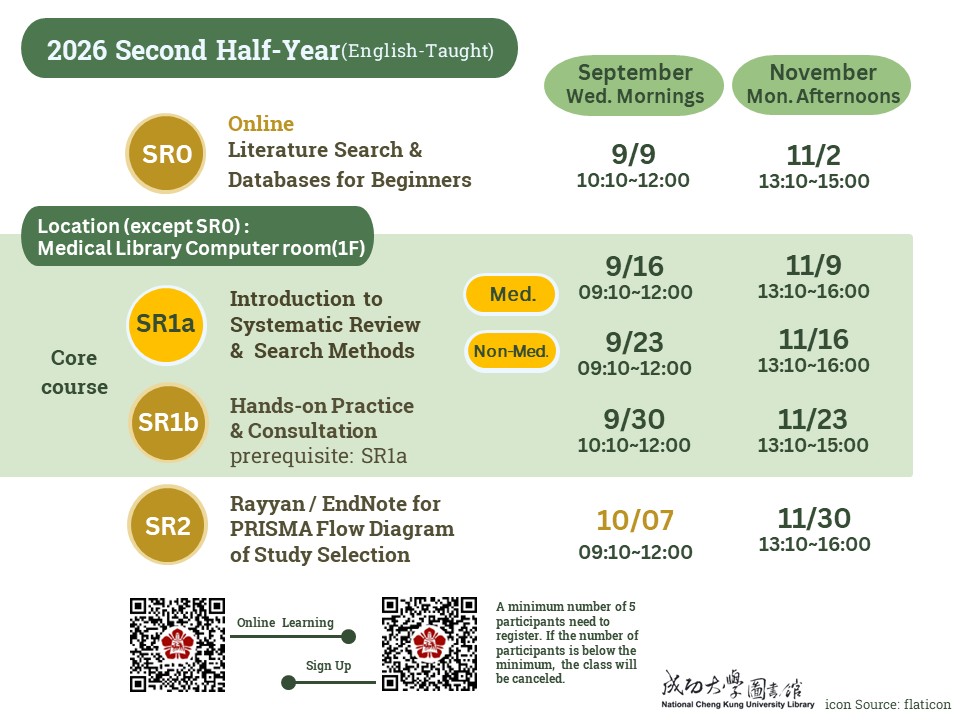
SR 0 Literature Search & Databases for Beginners
09-09 (Wed) 10:10~12:00, Online Class*
11-02 (Mon) 13:10~15:00, Online Class* (Sign Up)
You can choose one of SR1a:
SR 1a- Medical: Introduction to Systematic Review & Search Methods
09-16 (Wed) 09:10~12:00
11-09 (Mon) 13:10-16:00 (Sign Up)
SR 1a- Non-Medical: Introduction to Systematic Review & Search Methods
09-23 (Web) 09:10~12:00
11-16 (Mon) 13:10~16:00 (Sign Up)
SR 1b- Systematic Search Methods: Hands-on Practice and Consultation
09-30 (Web) 10:10~12:00
11-23 (Mon) 13:10~15:00 (Sign Up)
SR 2: Rayyan/EndNote for PRISMA Flow Diagram of Study Selection
10-07 (Wed) 09:10~12:00
11-30 (Mon) 13:10~16:00 (Sign Up)
Participation in BOTH 1a and 1b sessions in less than 6 months will be granted with a COURSE CERTIFICATE!